
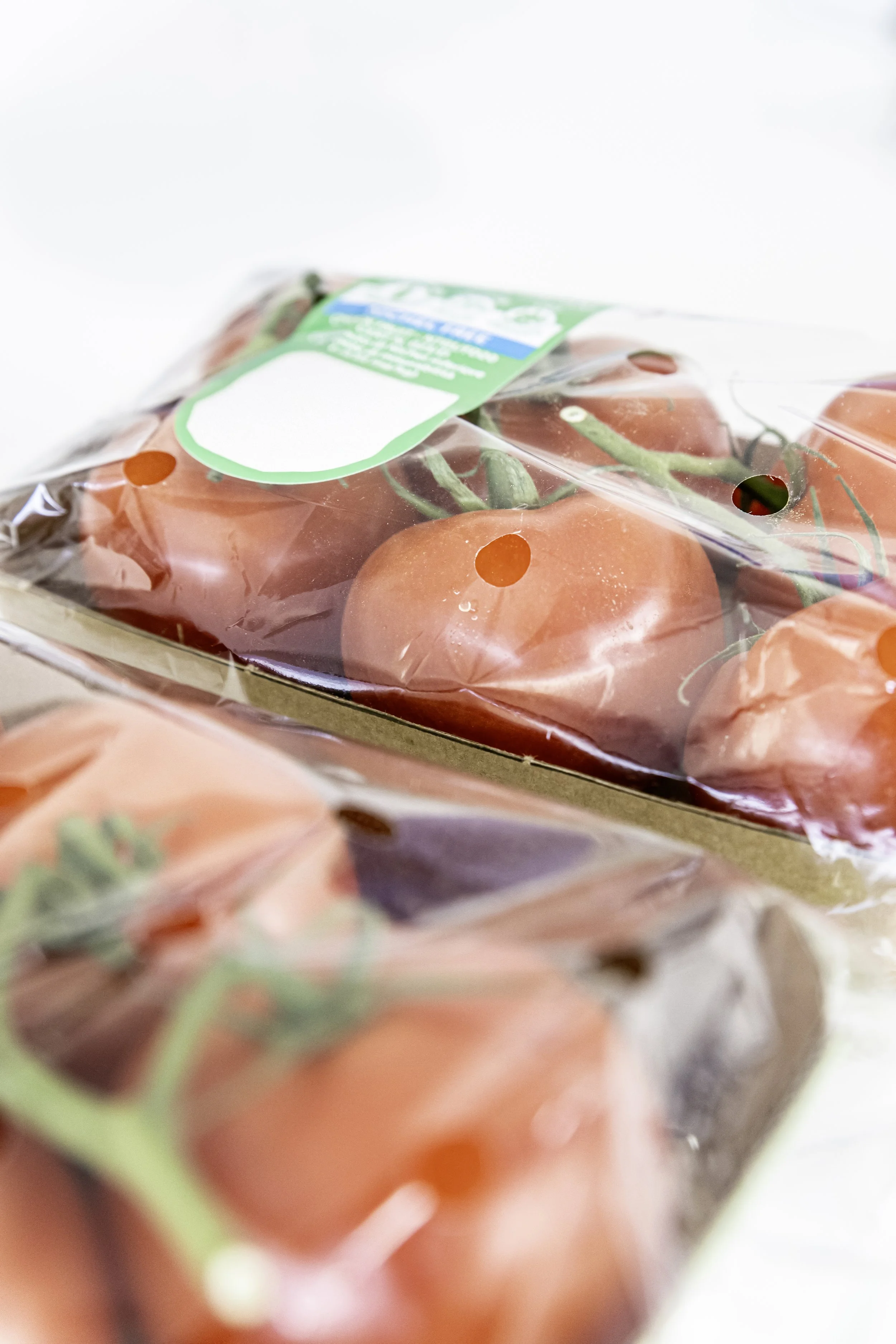
Moisture control packaging is packaging designed to manage moisture transfer and internal humidity according to what each product requires. When that management fails, condensation forms inside the pack, and the droplets can cloud the product’s appearance, soften its texture and reduce its quality. Selected foods, such as fresh fruit and vegetables, benefit from perforation, which allows a controlled exchange of moisture with the outside air. The aim is the appropriate moisture balance for each product, because drier is not always better.
Moisture control packaging: key points at a glance
Five points decide whether a pack stays clear or fogs up.
Cause: Condensation forms when humid air inside the pack meets a film surface cooler than its dew point.
Perforation and film: Matching hole size and number to a film with suitable permeability lets excess vapour escape.
Trade-off: More ventilation means less fogging but more water loss, so the product can dry out and lose weight.
Temperature: A stable cold chain prevents the swings that trigger droplets.
Validation: Test the finished pack with the real product under real storage conditions.
The right solution depends on the product and on its distribution conditions.
Why does condensation form inside packaging?

Water vapour inside a sealed pack has three sources: the product itself, which keeps releasing moisture after packing; humid air trapped at sealing; and residual moisture left on surfaces after washing.
That vapour turns to liquid when a surface, usually the film, reaches or falls below the dew point of the surrounding air. Temperature changes are the usual trigger. Food packed warm and then cooled, a pallet moved between a cold store and a loading bay during transport, or a pack placed in a refrigerated retail display can each leave the film colder than the air inside, and droplets appear.
Condensation is different from high relative humidity, which is invisible and often desirable for fresh produce. It also differs from liquid released directly by food, such as the drip from meat and seafood, which needs absorbent pads and not ventilation.
The consequences are practical: wet product surfaces, loss of crispness, a fogged film that hides the contents, and conditions that may favour spoilage.
How perforation helps control moisture in food packaging
An intact film lets water vapour through only by slow permeation of the material. Openings add direct pathways, so vapour and gases move between the pack and its surroundings far more quickly. Perforation does not absorb water or actively dehumidify a pack: it only allows exchange, always from the wetter side towards the drier one. Its effectiveness depends on the moisture gradient, temperature, film properties, the rate at which the product releases moisture, and package design.
-
Too little exchange lets moisture accumulate; too much increases weight loss, wilting or drying. In a study of fresh-cut carrot, laser-perforated bags lost about 1.7% of their weight in 12 days, against 3.8% for unpackaged slices.
Respiring produce adds a second requirement, because the same holes carry oxygen in and carbon dioxide out. Moisture management and gas-atmosphere management are separate objectives that share one route. In modified atmosphere packaging, a pattern that delivers the target gas composition does not guarantee a droplet-free film, so each must be checked on its own.
-
Microperforations are small openings for tailored exchange, suited to packs that must hold a specific internal atmosphere. Macroperforations are larger and suit products where generous ventilation matters more. No single pattern fits every pack: hole diameter, number, spacing and placement interact with film permeability, pack size and fill weight. In the carrot trial, three microscopic holes were already enough to bring oxygen close to ambient levels within four days. A perforated film also no longer provides the same continuous barrier as the equivalent unperforated film.
Where can perforated packaging help reduce condensation?
| Approach | Main function | Typical application | Key limitation |
|---|---|---|---|
| Perforation | Allows controlled exchange of vapour and gases | Fresh produce, warm-packed bakery | Lowers the barrier and can raise product water loss |
| Moisture-barrier films | Restrict moisture ingress | Cereals, snacks, powders | Do not remove moisture already inside |
| Desiccants | Capture water vapour | Sachets in dry foods and pharmaceuticals | Finite capacity that must match the moisture load |
| Anti-fog treatments | Spread condensed water into a thin, clear layer | Lidding films, salad packs | The water stays in the pack |
| Humidity indicators | Show humidity conditions | Shipments of electronics and components | Monitor only, with no control |
How to design and validate packaging that reduces condensation
A reliable pack comes from three steps, taken in order.
Define the product and distribution requirements
Start with the product: how much moisture it releases, how sensitive it is to drying, whether it respires, and the target shelf life. Add fill weight and pack dimensions. Then record the route: packing temperature, expected storage conditions, transport duration and likely temperature fluctuations. Cooling and cold-chain management remain part of the solution, because no hole pattern can compensate for a product sealed warm or a chain that repeatedly breaks.

Match the film and perforation process
Moisture leaves the pack by two routes: through the base film, described by its water vapour transmission rate, and through the openings. A transmission rate is valid only for the temperature and humidity at which it was measured, so check that those match the application. Material, thickness, hole geometry, density, placement and consistency all shape the result. Laser, hot-needle, cold-needle and macro-perforation are process options, and the suitable one depends on the film and the pattern required. Line speed, web handling and the need to keep holes clear of sealing areas narrow the choice further.
Test the finished pack under realistic conditions
Compare a few candidate films and patterns using the actual product and pack format; researchers concluded that outcomes depend on product quantity, pack size and hole count. Assess condensation, temperature and humidity, weight loss, texture, appearance and package integrity, and measure oxygen and carbon dioxide where MAP is intended. Include representative temperature changes and the full storage duration. A clear film is not proof of shelf life or safety: those conclusions require appropriate validation, such as microbiological testing.
Frequently asked questions about moisture control packaging
-
No. A suitable design reduces the risk, but the result depends on how much moisture the product releases, the film properties and the environment the pack passes through. A sharp temperature drop can still fog a well-ventilated pack for a time.
-
It can. Additional exchange increases moisture loss, which is why hole size and number are tested and not guessed. A validated design balances drying against moisture accumulation and, for fresh produce, against the gas exchange the product needs.
-
No. Anti-fog treatments change how droplets form and spread on the film surface, so the contents stay visible. A clearer film does not mean less water in the pack. The two approaches can be used together.
-
When the product needs strong protection from external humidity, oxygen or other environmental exposure. Dry foods such as cereals and corrosion-sensitive components are typical examples, although the choice should always follow the requirements of the specific product.
Talk to our experts – We’ll guide you to the right solution
Every product, film and supply chain sets different requirements, so the right perforation is one designed for your pack. Spark Machinery’s engineers can review your application, run perforation tests on your own film and recommend the process that fits your pattern and line speed, from laser and needle systems to macro-perforation.
Contact our team for a technical consultation and a perforation solution tailored to your packaging.